Member in Ukraine of IAPA (International Association of Professional Accountants)

"The service in outsourced accounting covers such basic areas as inventory and fixed assets bookkeeping, payroll etc."

Hannes Snellman Ukraine LLC

About Ukraine

| |

Introduction
Land and Climate
Ukrainian Culture and People
Economy of Ukraine - Overview
Kiev is the Capital of Ukraine
Administrative structure and Ukrainian cities
Government of Ukraine
10 interesting facts about Ukraine
History of Ukraine
Welcome to Ukraine

Introduction

Ukraine is the largest country in Europe (after European part of Russia). Ukraine is a country with more than a thousand years of history and traditions that originate in antiquity.

The time in Kiev is 7 hours later than US Eastern Standard, 2 hours later than Greenwich Mean. Ukraine covers one time zone. Daylight Saving Time is in effect from the first Sunday of April until the last Sunday of October.

Ukraine is member to numerous world and regional international bodies, including United Nations (UN), OSCE, the Council of Europe, EU Energy Community, the GUAM and the Commonwealth of Independent States (CIS). The country is currently taking steps to accede to EU and NATO, and has special partnership with both organisations.

Ukraine obtained a market economy status from both the USA and the EU and has also joined the World Trade Organization (WTO). Ukraine plans to enter into a free trade agreement with the EU in 2012-2014. Foreign direct investment (FDI) has continued to flow in, although in a relatively low volume.

In 1992 Ukraine became a member of the International Monetary Fund (IMF) and the International Bank for Reconstruction and Development (World Bank). It also became affiliated with the European Bank for Reconstruction and Development (EBRD).

Ukraine has anti-money laundering controls approved by the global Financial Action Task Force (FATF).


Switch on Ukraine

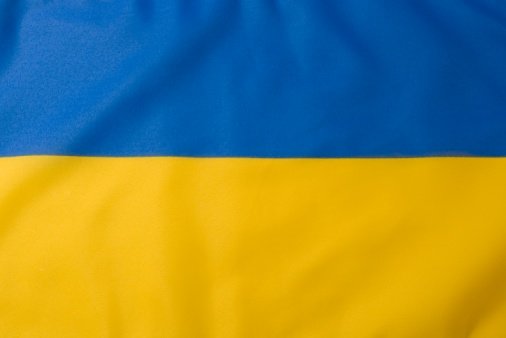
National Flag of Ukraine

The traditional Ukrainian symbols — trident and blue-and-yellow flag (proportions 3 by 2) — were officially adopted during Ukrainian independence in 1917–1920 and again after the Declaration of independence in 1991. The trident dates back to the Kievan Rus' as a pre-heraldic symbol of Volodymyr the Great. The national flag of Ukraine colors are commonly believed to represent blue skies above yellow wheat fields.

National Anthem of Ukraine

The Composition of the National Anthem of Ukraine dates back to the year of 1862, when young folklorist and ethnographer Pavlo Platonovich Chyubynsky wrote the poem “Ukraine is still alive”. The popular poem was noticed by religious leaders of those times. One of them, Father Mykhailo (Verbytsky), known to be a talented composer, wrote music to the poem (1865).

^ Back to top of article "About Ukraine" ^^ Back to top of section "Introduction"

Land and Climate

Land and Nature
Climate of Ukraine

Land and Nature

The territory of Ukraine is equal to 603,7 th sq km or 5,7% of European territory. It occupies the territory of Southern West part of East-European Plain, part of the Carpathians and the Crimean Mountains. The territory from North to South is 893 km, from West to East - 1316 km. Ukraine lies within moderate latitudes and has ports on the Black sea and the Azov sea. Geoposition between Eastern and Western peoples and cultures made a great impact on the history and now-a-day development of Ukraine. Ukraine has inland and marine borders of 7590 km.

The inland border passes for 5631 km and consists of 3 areas: Western, Eastern and Northern. The length of marine border is 1959 km. Ukraine borders on Russian Federation (inland border of 2063 km), Republic of Belarus (975 km), Republic of Poland (542,5 km), Republic of Slovakia (98 km), Hungary (135 km), Romania (608 km) and Republic of Moldova (1194 km).

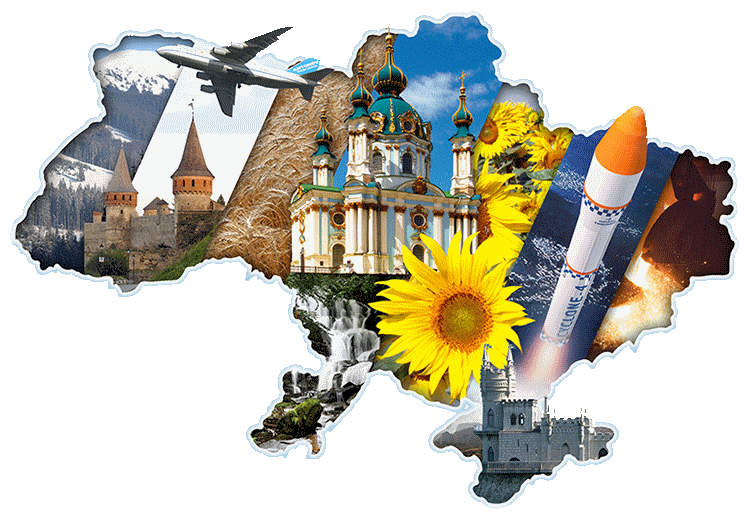
Map of Ukraine

Natural scenery of Ukraine is picturesque. Recreational landscapes occupy an area of 9.4 mln hectares (one hectare is about 2.5 acres). Forests cover about 14% of Ukraine’s territory. The longest mountain range in Ukraine is the Carpathians stretching for 270 km; the highest mountain is the Hoverla (2061 m). The Crimean Mountains are situated in the southern part of the Crimea, the southernmost extension of Ukraine (the highest mountain is 1545 m). Over 70,000 rivers flow through Ukraine. The major rivers are the Dnieper (in Ukrainian - "Dnipro") (third longest in Europe), the Dniester, Southern Buh, Siverskiy Donets, Prut, the mouth of the Danube is situated in Ukraine. There are over 3000 natural lakes and about 22,000 artificial water reservoirs in Ukraine, as well as many sources of mineral water and medicinal mud which are used to treat many diseases.


East Carpathians Biosphere Reserve is the largest biosphere reserve in Europe. The reserve covers 200,000 hectares
(in Poland 53%, in Ukraine 27% and in Slovakia 19% of the total area).

A network of 10 nature and biosphere reserves (including The Primeval Beech Forests of the Carpathians and Askania-Nova) and more than 100 wildlife refuges has been established to protect wildlife, especially beaver, lynx, elk, and muskrats. Birds include the Eurasian black vulture, steppe eagle, and gray heron. Ukraine has more than 200 species of fish, including pike, carp, and sturgeon. There are 25 species of domesticated animals, including cattle, hogs, sheep, and goats.

^ Back to top of article "About Ukraine" ^^ Back to top of section "Land and Climate"

Climate of Ukraine

The climate in Ukraine is similar to the wheat-producing regions of Canada and is characterized by abundant precipitation and cloudy skies, especially in fall and winter. The mean temperature in summer is 67°F (19°C) and in winter 21°F (-6°C). Although summers tend to be short, the temperature can rise to the 90°F (30°C) making it uncomfortable, since most buildings have no central cooling systems. Winters are long and cold, with cloudy skies as a norm.

Only a narrow coastal strip of the Southern coast of Crimea is characterized by sub-tropical (Mediterranean) climate.

Map of Ukraine: Climate.
© visitua.info

For more information, please see wikipedia.org

^ Back to top of article "About Ukraine" ^^ Back to top of section "Land and Climate"

Ukrainian Culture and People

Population
Education
Traditions
Religion
Public Holidays in Ukraine

Population

The population of Ukraine is 45,8 mln people. Ukraine is the 5th in Europe (after Germany, Italy, Great Britain, France) and the 21st in the World. Ukrainian population sets 7,3% of population of Europe and 0,8% of the World population. 68% of Ukrainians live in cities and 32% - in rural areas. Eastern Ukraine is much more urbanized than the west.

Map of Ukraine: Density of population.

The average density of population of Ukraine is 85 people per square kilometer. As per this indicator, Ukraine yields to many European countries. The density is not similar all over Ukraine. The most habitable is Donetsk’s region - 196 people per sq km. The less one – Chernigov (in Ukrainian - "Chernihiv") region – people per sq km.

Ukrainians are the largest nationality living in Ukraine, constituting 73% of the population. Russians make up another 21%, and they live primarily in cities and in Eastern Ukraine. The remaining 6% is divided between Jews, Belorussians, Moldavians, Bulgarians, and Poles.

The official language in Ukraine is Ukrainian although Russian is still the most widespread; other languages spoken in Ukraine are Romanian, Polish, and Hungarian. About 88% of the population consider Ukrainian their language. Many speak Russian as a first or second language, especially in Eastern Ukraine and Crimea.

Ukrainian language took the second place on melodic criteria after Italian and it was ranked as the third most beautiful language in the world on such criteria as phonetics, vocabulary, phraseology and sentence structure after French and Persian at a linguistic contest held in Paris in 1934.

^ Back to top of article "About Ukraine" ^^ Back to top of section "Ukrainian Culture and People"

Education

Higher education in Ukraine has centuries-old history, national traditions and high prestige in the world. One of Ukraine’s better known Universities is the National University of Kiev-Mohyla Academy, which is closely associated with the historical site called the Kiev Mohyla Academy found in Kiev, Ukraine. The Kiev Mohyla Academy was established in 1615, and was one of the most recognized schools in the Eastern Europe.

The system of higher education in Ukraine has flexible structure, corresponds to modern trends and tendencies to those in advanced countries recognized by UNESCO, UN Organization and many other international organization. Ukraine entered the international Bologna process ("The agreement of the Association of European Universities" of 1999) in 2005 to adapt to the European Educational system.

Every year almost 200 thousand Ukrainians and citizens of other countries become students of higher educational institutions in Ukraine.

The system of education provides good quality and is well developed. One of the most important tasks for central and local authorities is to give equal possibilities in getting top quality education for all citizens of Ukraine. All schools and universities in Ukraine require at a minimum one other foreign language (basically - English), and often two foreign languages are studied for 5+ years.

According to the United Nations Development Programme Report 2009, 99.7% of adults can read and write in Ukraine. Slovenia, Belarus, and Lithuania have the same level of literacy among European countries. As to Great Britain, France, Germany, and US the level of literacy is just under 99% there. The situation is worse in China – 95.9% and in India – 74.04%.

^ Back to top of article "About Ukraine" ^^ Back to top of section "Ukrainian Culture and People"

Traditions

Before Ukraine adopted Christianity in 988, the inhabitants believed in pagan gods who ruled over the sun, stars, and moon. Folk beliefs are still connected to the sun, stars, and moon, as well as to dreams, the seasons, and agriculture. In fact, many of the pagan customs blended, over time, with Christian beliefs. These centered on the family (e.g., birth, marriage, and funeral customs), the community, and seasonal agricultural rites.

Songs and folk tales play a significant role in these ancient customs. There are specific songs for harvest festivals, New Year's celebrations, and Christmas and Easter, all celebrating both pagan beliefs and Christian traditions. Songs and music have always been important to the Ukrainians.


Kupalo Song by the folk band "Vertep"

Examples of ancient customs still practiced today include the spring rites and songs (vesnianky) and the traditions associated with the harvest or Kupalo festival in which young maidens make wreaths of wildflowers, and set them afloat in a nearby stream; their fortune is determined by the young man who retrieves the wreath while facing the spirits of the night. Often these are still practiced by Ukrainian youth at cultural festivals.

^ Back to top of article "About Ukraine" ^^ Back to top of section "Ukrainian Culture and People"

Religion

Freedom of religion is guaranteed by the Constitution of Ukraine, although religious organizations are required to register with local authorities and with the central government. There is no formal state religion.

Most of the believers in Ukraine are Christians of several denominations: Orthodox (of two kinds) (76,5%), Greco-Catholic (of Ukrainian Catholic Rite and Byzantine Rite) (8%); Roman Catholics; and Protestants. There are also Judaists, Muslims (mostly among the Crimean Tatars) and representatives of other confessions in Ukraine.

^ Back to top of article "About Ukraine" ^^ Back to top of section "Ukrainian Culture and People"

Public Holidays in Ukraine

  • New Year’s Day - January 1. In addition to the traditional celebrations the Old New Year’s Day, a folk symbol of tradition and originality, is marked on January 14.
  • Ortodox Christmas Day - January 7
  • International Women’s Day - March 8
  • Velykden’ (Ortodox Easter) - movable: April 15, 2012; May 5, 2013; April 20, 2014; April 12, 2015
  • Labor Day - May 1 and 2 (2 days)
  • Victory Day - May 9
  • Svyata Triytsia (Holy Trinity Day) - movable: June 3, 2012; June 23, 2013; June 8, 2014; May 19, 2015
  • Constitution Day - June 28
  • Independence Day - August 24

Except Ortodox Easter and Svyata Triytsia, which mobility is linked to the religious tradition, all the above holidays are celebrated on a fixed day. Ortodox Christmas Day and Velykden’ (Ortodox Easter) are celebrated in accord to the Orthodox Old Calendar.

Important notice: In Ukraine, if a holiday falls on a weekend, there will be a day off on the following Monday.

^ Back to top of article "About Ukraine" ^^ Back to top of section "Ukrainian Culture and People"

Economy of Ukraine - Overview

Industry
Energy sector
Transportation system
Agriculture

Industry

Machine-building is the largest Ukrainian industrial sector. It accounts for over one-third of the employed and about a quarter of the total cost of industrial main assets. The rapid development of machine-building proved Ukraine’s ability to develop and manufacture complicated science-intensive and highly technological machines and equipment. Among the examples are development of the rocket and space industry (Zenit 3SL, Cyclone), aircraft building (AN-70, AN-140, “Mria”), production of advanced tankers and large-tonnage vessles, fabrication of turbines for nuclear power plants, highly-efficient gas-pumping installations, equipment for high-voltage power transmission lines, mining equipment, diesel locomotives, tractors etc.


Ukrainian Zenit 3SLB

The Ukrainian shipbuilding industry is a complex of colleges, universities and research centers; experienced design bureaus; 9 shipbuilding yards with different capacities and specialisation; and a number of ship repair yards. Close geographical location to European Union, combined with availability of up-to-date design bureaus, powerful production facilities of shipyards, experienced labor force, presence of strong national metallurgic industry make the Ukrainian shipbuilding industry very attractive alternative to distant shipbuilding centers.

The multi-branch chemical sector of Ukraine includes chemical, petrochemical and chemical-pharmaceutic sub-sectors with over 1,600 enterprises and structural units. The sector accounts for nearly 10% of industrial fixed assets and over 5% of all those employed by Ukrainian industrial sector.

The structure of the chemical sector includes two groups of enterprises – chemical and petrochemical ones. Within the structure of the industry, predominant are asset- and energy-intensive basic chemistry enterprises. This sector is represented by production of mineral fertilizers, non-organic acids and soda. Nitric fertilizers are manufactured in Donbass (Severodonetsk, Gorlovka) and Pridneprovie (Dneprodzerzhinsk). Rovno and Cherkassy enterprises use natural gas in their production. Phosphate fertilizers are manufactured in sugar-beet producing areas (Sumy, Vinnitsa) and in Odessa and Kostyantynov (Donetsk oblast). Production of sulfuric acid is concentrated in the regions where it is consumed and in the centers of phosphate fertilizers production. Basic chemistry is concentrated in the Crimea and comprises production of bromine, magnesium and iodine. Metallurgy is the largest key industry in the economy of Ukraine. Its importance is due to the fact that the machine building and metal-working industries depend on the production of ferrous and non-ferrous metals, and that metal is the main source of engineering materials and an important export article.

Chemical sector: OJSC Rivneazot (Rovno, Ukraine)
Rovno Azote Plant ("Rivneazot" Company)

Metallurgy is the largest key industry in the economy of Ukraine. Its importance is due to the fact that the machine building and metal-working industries depend on the production of ferrous and non-ferrous metals, and that metal is the main source of engineering materials and an important export article.

The metallurgy sector includes 14 integrated steel making plants, 7 pipe plants, 10 plants producing metallic articles, 16 merchant-coke plants, 17 refractory production plants, 3 ferroalloy plants, 20 non-ferrous metallurgical works, 35 factories reprocessing ferrous and non-ferrous scrap metal, and other enterprises.

Light and food industries in Ukraine relate to the social complex of consumer goods production. Light industry today is a multi-branch sector comprising 25 sub-sectors. They embrace over 3,300 enterprises of different forms of ownership and subordination. Until recently it had been very well developed in Ukraine and almost completely satisfied the needs of population in consumer goods.

Food industry is traditionally the major supplier of basic foods, such as sugar, salt, oil, alcohol, confectionery, etc. Food industry is the leader of the agro-industrial complex. It will remain strategically important in future, determining the well-being of the people. The sector has considerable production, research and labor potential. Among the major sub-sectors of the food industry are meat and dairy processing, sugar refining, flour milling and cereals production, oil extraction and starch and molasses production. The most significant centers of the food processing sector are Kiev, Kharkov, Odessa, Nikolaev, Donetsk, Zaporozhye, and Lvov.

^ Back to top of article "About Ukraine" ^^ Back to top of section "Economy of Ukraine - Overview"

Energy sector

The energy sector is of key importance for the national economic development, as both production and municipal facilities require electric power for their operation. The energy sector peculiarity is that the technological equipment and primary generators of electric energy are separated from consumers. As a result, power generation, transmission and distribution have become separate industries.

Rovno Nucclear Power Plant (Ukraine)
Rovno Nuclear Power Plant

Three types of generation facilities are operated in Ukraine, including thermal power plants (steam turbine and diesel types), hydroelectric plants (hydroelectric proper and hydroelectric accumulating plants) and nuclear power plants. The role of wind and helium power plants is growing.

Ukraine operates four nuclear power plants, including the Zaporozhye, South-Ukrainian, Rovno and Khmelnytsky, and hydroelectric power generation cascades (6 large hydroelectric power stations on the Dnieper and 55 small stations on other rivers).

Ukraine has high average wind speeds, a good solar radiation profile, plentiful biomass raw materials, and numerous dams on the Dnieper River, all ideally suited for renewable energy generation.

^ Back to top of article "About Ukraine" ^^ Back to top of section "Economy of Ukraine - Overview"

Transportation system

Overall, Ukraine has a well-developed and diverse transportation system. Ukrainian railroad network is extensive and links Ukrainian cities with industrial enterprises. Waterways such as Dnieper River and Black Sea and Azov sea, and their port cities (Feodosiya, Illichivsk, Mariupol, Nikolaev, Odessa, Yushny, and Sevastopol), play an important role in shipping.

Ukrainian highway system comprises about 147,000 kilometers (91,000 miles) of paved roads. Ukrainian subway systems exist in Kiev, Dnepropetrovsk and Kharkov. Buses small and large whisk passengers along all major city streets in all possible directions. The deepest in the world subway (metro) station is located in the Ukrainian capital, Kiev. It is Arsenal’na metro station (red line) and its depth is 105 meters.

Street trams and trolleybuses — the cheapest forms of transportation — plug slowly along their routes.

Kiev International Airport Borispol
Kiev International Airport "Borispol" (in Ukrainian "Borispil")

There are major international airports near Kiev (at Borispol), Donetsk, Kharkov, Lvov and Odessa cities.

^ Back to top of article "About Ukraine" ^^ Back to top of section "Economy of Ukraine - Overview"

Agriculture

Historically, Ukraine is well known for its agricultural production. Ukraine has 60.300 hectares of land. Of this, 70% is agricultural land, 17% is used for forestry, the rest is for housing, industrial and other purposes (used as state reserves, for recreation etc). Ukraine’s agricultural sector employs 23.1 percent of the work force.

Ukraine's farms produce large amounts of potatoes and grains such as wheat, corn (maize), and barley. Potatoes, a food staple, are also grown for making starch and alcohol. Ukraine is one of the world's leading producers of sugar beets. Sunflowers are cultivated for their seed oil and latex. Other major crops include tomatoes, cabbages, squash, apples, and sour cherries. Beekeeping, silkworm raising, and fish farming also contribute to the country's economy. Large numbers of cattle are raised for meat and milk. Other livestock include poultry, pigs, sheep, and goats.

Ukraine is the biggest exporter of sunflower oil.

Fertile soil makes it possible to grow a variety of crops. Being a large grain producer, Ukraine is one of the six world largest exporters, supplying to 80 countries worldwide. The country is also the biggest exporter of sunflower oil and has substantial potential in growing and exporting rapeseed.

For more information, please see www.worldbank.org.ua

^ Back to top of article "About Ukraine" ^^ Back to top of section "Economy of Ukraine - Overview"

Kiev is the Capital of Ukraine

Kiev (Kyiv) is one of the more beautiful and one of the oldest cities of Eastern Europe and has played a pivotal role in the development of the East Slavic civilization as well as in the modern Ukrainian nation. Founded 1500 years ago, Kiev is the capital of independent Ukraine and Kiev region. Kiev is scientific and cultural center of Ukraine. Kiev has population of 2.6 mln.

Kiev's most famous historical architecture complexes are the St. Sophia Cathedral, where the princes of Kiev were crowned in the years of Kiev's grandeur, and the Kiev Pechersk Lavra (Monastery of the Caves), has two 11th-century cathedrals on its grounds, in addition to its world-famous catacombs, which are recognized by UNESCO as a World Heritage Site.


Welcome to Kiev, presentation for EURO 2012

Also of interest are the ruins of the 11th-century Golden Gate, once the main entrance to the city. Kiev is the site of several universities, most notably the University of Kiev (founded in 1834). The Ukrainian Academy of Sciences and its Central Library, Ukraine’s largest library, are located in Kiev. Kiev is a modern city with many monuments, more than 100 museums (including the National Museum of the History of Ukraine (1899), the National Museum of Natural History, the National Art Museum of Ukraine, Pirogovo), 33 theatres (including a Music Conservatory, National Opera of Ukraine), zoo and a large sports stadium.

Being the largest city of Ukraine, Kiev is a leading industrial and commercial center of the country. Kiev's major industries include: food processing (especially processing of beet sugar), metallurgy, manufacture of machinery, machine tools, rolling stock, chemicals, building materials, and textiles. The development of Ukrainian economy gave impulse to business activity of the city. There are a lot of new office centers, banks, trade exhibition centers and other commercial enterprises appearing in the city nowadays.

Kiev is known as the most green city. The area of the green zone covers 43,600 hectares (making up 168 sq.m per one resident), more than half of which is taken up by woods, public gardens, two botanical gardens, parks and tree-lined boulevards. At the United Nations Climate Change Conference 2009 Kiev was the only CIS city to have been inscribed into the TOP30 European Green City Index.

Kiev is served by a good transportation network. Trunk railways and all-weather roads link Kiev to Moscow, Kharkiv and the Donets Basin, southern and western Ukraine, and Poland. Within Kiev city itself there is efficient subway, rail, and bus service. The Dnieper River is navigable about nine months of the year, and Kiev’s Boryspil airport operates flights to other Ukrainian cities and to cities in Europe, Asia, and North America.

Interesting facts about Kiev

  • Archeological excavations show evidence of the first settlements on the territory of Kiev 15,000 to 20,000 years ago.
  • Kiev was the first ever capital of Kievan Rus', the first Russian state (late 9th century - 1240). It was built on the lands of the Polyan tribal union, but it later incorporated all the Eastern Slavic tribes.
  • In 988 Prince Vladimir introduced Christianity to Kievan Rus. From Kiev began the Russian Christianity and the Orthodox culture.
  • Kiev known to Russians as the "mother of Russian cities".
  • Kiev was the largest town in XI century Europe, fifty times the size of London, ten times the size of Paris. It reached the height of its prominence under the rule of Yaroslav the Wise (1010-1054 AD), who had family connections to the royal houses of France, Norway, Hungary, and Poland.
  • At the end of the 15th century Kiev was the Magdeburg law.
  • Administratively, the city is divided into "raions" ("districts"), which have their own locally elected governments with jurisdiction over a limited scope of affairs. Presently, there are 10 raions.
  • Kiev's unofficial logo is chestnut. May is the most beautiful month in Kiev when chestnuts bloom.
  • Kiev will play a leading role in hosting the Euro 2012 Football Championships.
  • The standard time in Kiev is 2 hours later than GMT/UTC (Daylight Savings Time: EEST (UTC+3).

^ Back to top of article "About Ukraine" ^^ Back to top of section "Kiev is the Capital of Ukraine"

Administrative structure and Ukrainian cities

Ukraine is a unitary republic, not a federal state. The country is divided administratively into 24 provinces called "oblasti"; two cities — Kiev and Sevastopol — carry the same status as an oblast. The Crimea is an autonomous republic within Ukraine. There are 447 towns and 28,800 villages in Ukraine.


About Ukraine

The largest cities in Ukraine (all have a population of over one million) are:

Kiev (in Ukrainian - "Kyiv"), the biggest city in Ukraine, capital of Ukraine and economic, cultural, and educational center, has a population of 2.6 mln;
Kharkov (in Ukrainian -"Kharkiv"), noted for its engineering expertise, machinery plants, and educational institutions;
Dnepropetrovsk (in Ukrainian - "Dnipropetrivsk"), a center of metallurgical and aerospace industries;
Donetsk, known for mining and metallurgy;
Odessa (in Ukrainian - "Odesa"), on the Black Sea coast, is the country's largest seaport.

^ Back to top of article "About Ukraine" ^^ Back to top of section "Administrative structure and Ukrainian cities"

Government of Ukraine

Ukraine has a presidential-parliamentary system of government with separate executive, judicial, and legislative branches.

President is due to prevent any actions of the legislative, executive and judicial branches of power that directly or indirectly infringe the Constitution of Ukraine. With the aim of fulfilling this duty the President is vested with corresponding authorities. He is empowered to suspend decisions of government bodies and veto laws passed by the Verkhovna Rada (the Supreme Council of Ukraine).

The government, the Cabinet of Ministers of Ukraine, which consists of the Prime Minister of Ukraine, First Vice Prime Minister, Vice Prime Ministers and various departmental Ministers, exercises executive power in Ukraine. The Prime Minister is appointed by the President with the consent of more than one-half of the parliament.

The Cabinet of Ministers of Ukraine provides for carrying out financial, price, investment and taxation policies, as well as actions in the spheres of labor and employment of population, social protection, education, science and culture, environment protection, ecological security and nature management.

The Cabinet of Ministers works out the draft of the Law on the State Budget of Ukraine for approval by the Verkhovna Rada, and ensures its execution.

The Supreme Council (Verkhovna Rada) initiates legislation, ratifies international agreements, and approves the budget. The unicameral legislature consists of the 450-seat Supreme Council, whose members (People's Deputies of Ukraine) are elected to serve five-year terms. All parties that win at least 3% of the national vote in the parliamentary election are awarded seats on a proportional basis.

The judicial branch is very complex and has several independent court systems such as constitutional, the Constitutional Court of Ukraine, and general, the Supreme Court of Ukraine.

The Constitutional Court of Ukraine is separate and independent from courts of general jurisdiction. It cannot be a court of Appeal, Cassation and Observation. The activity of the Constitutional Court provides constitutional control in all the spheres.

The Supreme Court is the highest judiciary body. Courts are the only bodies to provide justice in Ukraine. The system of courts is based on the territorial and specification principles.

^ Back to top of article "About Ukraine" ^^ Back to top of section "Government of Ukraine"

10 interesting facts about Ukraine

1. The geographical centre of Europe is situated in the territory of Ukraine, not far from the city of Rakhov in Zakarpattia region.

2. The grave of the founding rabbi of Hassidism, situated near Uman', is a pilgrimage site for Hasidic Jews.

3. The first state constitution in Europe was created by a Ukrainian politician Pylyp Orlyk. On April 5th, 1710 he was elected the Hetman of Zaporozhye troops. On the same day Pylyp Orlyk has announced "the Constitution of the rights and freedoms of Zaporizhye army". For example, U.S. Constitution was adopted in 1787 and French and Polish in 1791.

4. The first computer in continental Europe was built in Kiev under the supervision of the scholar Sergey Lebedev and well-known scientist Victor Glushkov in 1950.

Ukrainian AN-225 Mria - the biggest and heaviest aircraft in the World.
Ukrainian AN-225 Mria as the basis for the aerospace systems.

5. AN-225 “Mria” (from Ukrainian – “a dream”) is today the biggest and the heaviest aircraft with the highest cargo capacity in the World. This unique cargo plane was constructed in the 1980′s by the Antonov’s Development Laboratory (Kiev, Ukraine). Its length is 84 m, height – 18 m, total cargo capacity – 250 tons.

6. Ukraine contains around 5% of the worlds mineral resources.

7. More than 12 million foreign tourists visit Ukraine each year, to see the Carpathian Mountains, the coastline of the Black Sea, the Dnieper River, vineyards, ruins of ancient cities and castles; ancient churches, cathedrals, and monasteries; world-class opera and ballet, and more.

8. Ukraine has the World’s 5th largest and fastest growing IT outsourcing services market in the World, with revenues in 2011 expected to reach $1 billion.


Modern Ukrainian ethnic song "I know" by Ruslana - Winner of Eurovision Song Contes 2004.

9. Famous people that are Ukrainian or of Ukrainian extraction are Vitali and Vladimir Klitschko, Andrey Shevchenko, Vasyl Virastyuk, Sergey Korolev, Vladimir Vernadsky, Ilya Mechnikov, Simon Kuznets, Nikolay Amosov, Mikhail Bulgakov, Ilya Repin, Kazimir Malevich, Sergei Prokofiev, Ruslana and many others.

10. Ukrainian Americans are citizens of the United States who emigrated to the United States or are of Ukrainian ancestry. According to US census estimates, in 2006 there were 961,113 Americans of Ukrainian descent representing 0.33% of the American population. Most famous Ukrainian Americans are Igor Sikorsky, Max Levchin, Vladimir Horowitz, Andy Warhol (Andrew Warhola), Jack Palance (Volodymyr Palahniuk), David Copperfield, David Duchovny, Steven Spielberg, Milla Jovovich, Leonardo DiCaprio, Dustin Hoffman, Michael Douglas, Sylvester Stallone, Johnny Depp and others.

^ Back to top of article "About Ukraine" ^^ Back to top of section "10 interesting facts about Ukraine"

History of Ukraine

The Trypillian culture and the Neolithic period in Ukraine
Kievan Rus’
Polish-Lithuanian Commonwealth
Cossack era
Russian Empire and Soviet Union
Independence of Ukraine

The Trypillian culture and the Neolithic period in Ukraine

Perhaps the most sophisticated culture of the early Neolithic Period in Europe, the Trypillian culture existed on Ukrainian territories for over three millennia. During the 6th millennium BC, Trypillian tribes began settling in low-lying riverbank areas and on plateaus in the Dnieper River and Boh River basins. They were, most probably, primitive agricultural and cattle-raising tribes that migrated to Ukraine from the Near East and from the Balkans and Danubian regions. Scholars have identified three periods in the development of this culture--early (5400-3500 BC), middle (3500-2750 BC), and late (2750-2250 BC). The differentiation of periods is characterized by an increase in population and the geographic spread of the culture as well as by changes in settlement patterns, the economy, and the spiritual life of the people.

As a result of incursions by other cultures (particularly the Pit-Grave culture) into Ukrainian territory during the Copper Age in the mid-3rd to early 2nd millennium BC, many characteristic Trypillian traits changed, were absorbed by other tribes, or disappeared.

^ Back to top of article "About Ukraine" ^^ Back to top of section "History of Ukraine"

Kievan Rus’

In the 9th century the Varangians from Scandinavia conquered the proto-Slavic tribes on the territory of today's Ukraine, Belarus, and western Russia and laid the groundwork for the Kievan Rus’ state. Kiev became the centre and capital of the new realm. The first period of Kievan Rus’ history can be characterized as the era of expansion, which saw Kiev extend its authority over all of the east-Slavic tribes.

The second period, associated primarily with the reigns of Vladimir the Great and Yaroslav the Wise, was the era of internal consolidation as a result of which Kievan Rus’ became one of the pre-eminent states of Europe.

In the 11th century, Kievan Rus' was, geographically, the largest state in Europe. During this time, Ukraine became known in the rest of Europe as Ruthenia (the Latin name for Rus', especially after the separation of Russia from Rus' propria). In addition, the name "Ukraine" first appears in recorded history on maps of the period. The term, "Greater Rus'" was used to apply to all the lands ruled by Kiev, including those that were not just Slavic, but also Finno-Ugric in the northeast portions of the state. Local regional subdivisions of Rus' appeared in the Slavic heartland, including, "Belarus'" (White Ruthenia), "Chorna Rus'" (Black Ruthenia) and "Cherven' Rus'" (Red Ruthenia) in northwestern and western Ukraine.

The internecine wars between Rus' princes, which began after the death of Yaroslav the Wise, led to the political fragmentation of the state into a number of principalities. In the Ukrainian lands, the Kiev principality, Turov-Pinsk principality, Vladimir-Volynskiy principality, Halych principality, Chernigov principality, and Pereiaslav principality emerged as independent and separate entities, with their own political and economic peculiarities. The quarreling between the princes left Rus’ vulnerable to foreign attacks, and the invasion of the Mongols in 1236 finally destroyed the state.

^ Back to top of article "About Ukraine" ^^ Back to top of section "History of Ukraine"

Polish-Lithuanian Commonwealth

During the 14th century, Poland and Lithuania fought wars against the Mongol invaders, and eventually most of Ukraine passed to the rule of Poland and Lithuania. More particularly, the lands of Volynia in the north and north-west passed to the rule of Lithuanian princes, while the south-west passed to the control of Poland (Galicia) and Hungary (Zakarpattia).

Most of Ukraine bordered parts of Lithuania, and some say that the name, "Ukraine" comes from the local word for "border", although the name "Ukraine" was also used centuries earlier. Lithuania took control of the state of Volynia in northern and northwestern Ukraine, including the region around Kiev (Rus'), and the rulers of Lithuania then adopted the title of ruler of Rus'. Poland took control of the region of Galicia. Following the union between Poland and Lithuania, Poles, Germans, Armenians and Jews migrated to the region.

After the Union of Lublin in 1569 and the formation of the Polish-Lithuanian Commonwealth Ukraine fell under Polish administration, becoming part of the Crown of the Polish Kingdom. The period immediately following the creation of the Commonwealth saw a huge revitalisation in colonisation efforts. Many new cities and villages were founded. New schools spread the ideas of the Renaissance; Polish peasants arrived in great numbers and quickly became mixed with the local population; during this time, most of Ukrainian nobles became polonised and converted to Catholicism, and while most Ruthenian-speaking peasants remained within the Eastern Orthodox Church, social tension rose.

Ruthenian peasants (Ukrainians and some from other nations) who fled efforts to force them into serfdom came to be known as Cossacks and earned a reputation for their fierce martial spirit. Some Cossacks were hired by the Commonwealth (became "register Cossacks") as soldiers to protect the southeastern borders of Poland from Tatars or took part in campaigns abroad (like Petro Konashevych-Sahaidachny in the battle of Khotyn 1621). Cossack units were also active in wars between the Polish-Lithuanian Commonwealth and Muscovy.

^ Back to top of article "About Ukraine" ^^ Back to top of section "History of Ukraine"

Cossack era

Hetman Bohdan Khmelnytsky is one of the most celebrated and at the same time most controversial political figures in Ukraine's early-modern history. A brilliant military leader, his greatest achievement in the process of national revolution was the formation of the Cossack Hetman state of the Zaporozhian Host (1648-1782). His statesmanship was demonstrated in all areas of state-building - in the military, administration, finance, economics, and culture. At the same time, at the height of the Cossack-Polish War (1648-1657), Khmelnytsky concluded the fateful Pereiaslav Treaty of 1654 with Tsar Aleksei Mikhailovich of Muscovy, as a result of which Ukraine became a protectorate of the tsar and was placed in the Muscovite sphere of influence. Some of the most prominent Ukrainian intellectuals, such as Taras Shevchenko, criticized Khmelnytsky for this strategic error which resulted in the centuries of Muscovite/Russian domination over Ukraine.

The Khmelnytsky Uprising and the Cossack-Polish War led to the establishment of the Cossack Hetman state. At the time of Bohdan Khmelnytsky's death, the Cossacks controlled the former Kiev, Bratslav, and Chernigov voivodeships, an area inhabited by about 1.5 million people. The entire area was divided into 16 military and administrative regions corresponding to the territorially based regiments of the Cossack army. At the pinnacle of the Cossack military-administrative system stood the hetman. Assisting the hetman was the General Officer Staff, which functioned as a general staff and a council of ministers. The capitals of the Hetman state were Chyhyryn (1648-1663), Hadiach (1663-1668), Baturyn (1669-1708 and 1750-1764), and Hlukhiv (1708-1734). From 1654 the Hetman state was nominally a vassal of Muscovy. The political relationship between the two countries was renegotiated with the election of each new hetman, which led to the steady erosion of the Hetmanate's sovereignty. In the 18th century, the increasing political control of the Hetman state by Russia precluded the independent evolution of its administrative, financial, and judicial institutions. During the reign of Catherine II (1762-1796) Ukrainian autonomy was progressively destroyed and the office of hetman was finally abolished by the Russian government in 1764.

^ Back to top of article "About Ukraine" ^^ Back to top of section "History of Ukraine"

Russian Empire and Soviet Union

Tsarist rule over central Ukraine gradually replaced 'protection' over the subsequent decades. After the Partitions of Poland in 1772, 1793 and 1795, the extreme west of Ukraine fell under the control of the Austrians, with the rest as part of the Russian Empire. As a result of Russo-Turkish Wars the Ottoman Empire's control receded from south-central Ukraine, while the rule of Hungary over the Transcarpathian region continued. Ukrainian writers and intellectuals were inspired by the nationalistic spirit stirring other European peoples existing under other imperial governments and became determined to revive the Ukrainian linguistic and cultural traditions and re-establish a Ukrainian nation-state, a movement that became known as Ukrainophilism.

Russia, fearing separatism, imposed strict limits on attempts to elevate the Ukrainian language and culture, even banning its use and study. This led to an exodus of a number of Ukrainian intellectuals into Western Ukraine. However, many Ukrainians accepted their fate in the Russian Empire and some were to achieve a great success there. Many Russian writers, composers, painters and architects of the 19th century were of Ukrainian descent. Probably the most notable were Nikolai Gogol, one of the greatest writers in the history of Russian literature, and Pyotr Ilyich Tchaikovsky, one of the greatest composers in the history of Russian music, whose father came of Ukrainian Cossack stock.

The fate of the Ukrainians was far different under the Austrian Empire where they found themselves in the pawn position of the Russian-Austrian power struggle for the Central and Southern Europe. Unlike in Russia, most of the elite that ruled Galicia were of Austrian or Polish descent, with the Ruthenians being almost exclusively kept in peasantry. During the 19th century, Russophilia was a common occurrence among the Slavic population, but the mass exodus of Ukrainian intellectuals escaping from Russian repression in Eastern Ukraine, as well as the intervention of Austrian authorities, caused the movement to be replaced by Ukrainophilia, which would then cross-over into the Russian Empire. With the start of World War I, all those supporting Russia were rounded up and massacred by the Austrian forces at Talerhof.

Shortly after the October Revolution of 1917, a military struggle for control of Ukraine began and was waged intermittently until 1921 by Ukrainian independentist forces and pro-Bolshevik elements seeking to establish Soviet rule. Notwithstanding the creation of the Ukrainian National Republic (UNR) on 20 November 1917, the Bolsheviks planned to seize power in Ukraine with the aid of Russian or Russified urban elements, Russian garrisons, and army units stationed near the front. Their armed uprising in Kiev on 11 December 1917 was unsuccessful, however, and the Bolshevized army units were deported from Ukraine in stages. A pro-Bolshevik force under Yevheniia Bosh moving in on Kiev was also disarmed by Ukrainian troops under Pavel Skoropadsky and then sent off to Russia. However, in December 1917 a 30,000-strong Red Guards army from Russia set off for Ukraine starting the war that would eventually lead to the establishment of Soviet rule in all of central and eastern Ukraine.

The national-communist policies of Ukrainization grew out of the weakness of early Soviet governments in Ukraine following the Revolution of 1917 and the failed Ukrainian struggle for independence. As early as 1920 Mykola Skrypnyk attributed this weakness to national hostility between the Ukrainian peasantry and the Russified workers, which was reflected in the Ukrainophobic policies of the Soviet authorities. The way to legitimize Soviet rule in Ukrainian eyes lay in the gradual de-Russification of the proletariat in Ukraine and its adoption of Ukrainian culture. The Borotbists, led by Oleksander Shumsky, offered a similar analysis. Despite widespread opposition to Ukrainization within the largely Russian CP(B)U, ex-Borotbists, such as Shumsky, Vasyl Blakytny, Serhii Pylypenko, and Mykhailo Semenko, were given considerable authority over Ukrainian cultural policy. Under Skrypnyk's supervision all postsecondary education was rapidly Ukrainized while the Ukrainian language was promoted among the government bureaucracy and in the military. This process resulted, among others, in the brilliant flourishing of Ukrainian literature (led by such writers as Mykola Khvylovy), culture, and scholarship. The successes of Ukrainization fostered the myth that Ukrainians had achieved a measure of national liberation within the Soviet framework, but the hopes of the national communists were brutally quashed. As part of wide-ranging repressions directed against Ukrainians, in 1932 Stalin ordered the CP(B)U to halt the implementation of Ukrainization and root out 'national deviations' from the Party line. The 1933 Party purge singled out 'national communists' as primary targets. The suicide of Khvylovy in May 1933 and that of Skrypnyk in July 1933 mark the end of openly expressed national-communist ideas in Ukraine.

Ukraine is one of founding members of United Nations

After World War II some amendments to the Constitution of the Ukrainian SSR were accepted, which allowed it to act as a separate subject of international law in some cases and to a certain extent, remaining a part of the Soviet Union at the same time. In particular, these amendments allowed the Ukrainian SSR to become one of founding members of the United Nations (UN) together with the Soviet Union and the Byelorussian SSR.

This was part of a deal with the United States to ensure a degree of balance in the General Assembly, which, the USSR opined, was unbalanced in favor of the Western Bloc. In its capacity as a member of the UN, the Ukrainian SSR was an elected member of the United Nations Security Council in 1948–1949 and 1984–1985.

Over the next decades, the Ukrainian republic not only surpassed pre-war levels of industry and production but also was the spearhead of Soviet power. Ukraine became the centre of Soviet arms industry and high-tech research. The republic was also turned into a Soviet military outpost in the cold war, a territory crowded by military bases packed with the most up-to-date weapons systems.

However, the relatively underdeveloped industrial branches such as coal- and iron ore mining, metallurgy, chemical and energy industry dominated the republic's economy. Once a Cossack steppe, the southern oblasts of Dnepropetrovsk and Zaporozhye were turned into a highly industrialised area with rapidly increasing impact on its environment and public health. A pursuit to energy production sufficient for growing industry led to the gigantic nature-remastering: turning the Dnieper River into a regulated system of large reservoirs.


Main tank T84 "Oplot" by the Malyshev Plant (Kharkov) is heritage of the Soviet military-industrial complex.

The products of the rapidly developed high-tech industry in Ukraine were largely directed for military consumption, similarly to much of the Soviet economy, and the supply and quality of consumer goods remained low compared even to the neighboring countries of the Eastern bloc. A state-regulated system of production and consumption lead to gradual decrease of quality of life and growing "shadowisation" of retail infrastructure as well as of corruption.

The town of Pripyat, Ukraine was the site of the Chernobyl disaster, which occurred on April 26, 1986 when a nuclear plant exploded. The fallout contaminated large areas of northern Ukraine and even parts of Belarus. This spurred on a local independence movement called the Rukh that helped expedite the break-up of the Soviet Union during the late 1980s.

^ Back to top of article "About Ukraine" ^^ Back to top of section "History of Ukraine"

Independence of Ukraine

Reforms initiated by Mikhail Gorbachev in USSR in spring 1985 were first controlled by the state party. But with the expansion of publicity (“glasnost”) there remained even less people who could find any harmony in relations between the State and society. Communist ideology lost its authority, the society was quickly politicized. These processes immediately acquired political coloration in Ukraine. There began the actions of protest against closing the schools with education in Ukrainian, against forcing out the national language from the sphere of state management, book-publishing, mass media.

On the evening of August 19, 1991, the conservatives of the central party-state management made an attempt of the state upheaval, striving to turn the country life to the state before 1985. The putsch (the leaders of the Central Committee of the Communist Party of Ukraine who also participated) was a failure. On August 24, the extraordinary session of the Supreme Council of the Ukrainian SSR approved “The Bill of Independence Announcement of Ukraine”.

In the last days of August 1991, they adopted the edict about temporal cessation and then the prohibition of activities of the Communist Party of Ukraine. On December 1, 1991, the referendum on confirmation of “The Bill of Independence Announcement of Ukraine” took place. There was a positive response from 90.3% of the population who took part in the referendum. The elections of the first President of Ukraine were also held. Leonid Kravchuk became the first President of Ukraine.

Ukraine's nuclear disarmament

After the disintegration of the USSR, Ukraine inherited the third largest nuclear potential in the world. In December 1991, the Supreme Rada resolved the law “On Military Powers of Ukraine”, and in November 1993, adopted the military doctrine in which it was announced that Ukraine did not see its enemies in the neighboring countries and the army of Ukraine is only a guarantee of its national security. Beginning with the Declaration on State Sovereignty, Ukraine always emphasized the desire to become a non-nuclear state. In November 1994, the Supreme Rada approved the decision on Ukraine joining the Agreement on non-expansion of nuclear weapons on the condition of guaranteeing safety on the part of nuclear states. Such guarantees were given and in the summer of 1996, the last 1280 nuclear warheads were removed from Ukraine.

^ Back to top of article "About Ukraine" ^^ Back to top of section "History of Ukraine"

Welcome to Ukraine


Welcome to Ukraine

^ Back to top of article "About Ukraine" ^^ Back to top of section "Welcome to Ukraine"

© 2001-2013 Units Consulting Ltd. Audit and accounting firm (Ukraine, Kiev): financial audits, review services, financial due diligence,
bookkeeping outsourcing in Kiev, payroll services, tax and finance accounting, fixed assets inventory services in Ukraine.
Designed by Special.net.ua All rights reserved

Rambler's Top100